Express Delivery & Free Returns
Import Duties and Taxes paid
Express Delivery & Free Returns
Import Duties and Taxes paid

ME+EM STATEMENT FOR THE 2025 – 26 REPORTING YEAR
This is our fifth statement under the UK Act, outlining our current strategies to prevent and mitigate modern slavery within our business and wider relationships and to highlight areas of focus for the coming year.
Whilst modern slavery exists in all sectors, we recognise that there are heightened vulnerabilities within our industry due to the complexity of supply chains and the labour practices within the industry and particularly in lower tiers of the supply chain. ME+EM does not tolerate any form of the above examples of modern slavery within our supply chains or direct relationships.
We are actively committed to supporting our supply chain partners in the prevention and mitigation of modern slavery and through our own direct business relationships, as outlined in this statement.

1 | Our business and supply chain
- Our story and commitment
- CSR Governance
- ME+EM direct employees
- Partnerships and standards
- Positive Luxury
2 | Supply Chain and Sourcing
- Our supply chain and sourcing
- Supply chain overview
3 | Due Diligence and Risk Management
- Supplier auditing
- Reporting
- Cotton sourcing and banned regions
- Whistle blowing + grievance mechanisms
- Freedom of association + collective bargaining
- Supply chain risk assessment
- Compliance and policies
4 | 2025-2026 Review + Learnings
- Our achievements
- Activity highlights
- Reflections + learnings
5 | Training + Communication
6 | 2026-2027 Objectives + Targets
OUR STORY
Founded in 2009 by Clare Hornby, ME+EM is a direct-to-consumer luxury brand defined by four core pillars: flattering, functional, fair, and forever. Based in White City, West London, ME+EM employs over 433 people. Including 169 store employees and 264 head office employees. We are a digitally native, international brand with 12 UK stores, 3 UK concessions (Selfridges London, Manchester, and Harrods London), 7 US stores, and a third party managed warehouse in Leeds.
By maintaining direct control over design and distribution, we cultivate close, transparent supplier relationships rooted in our shared values. Our dedicated CSR team and robust governance framework ensure rigorous accountability, driving continuous improvement as we identify and mitigate modern slavery risks across our global operations.
As the brand and the fashion industry have evolved, our commitment to fairness and responsibility has deepened. We continually review every aspect of our business to make more responsible choices; for our planet, our people, and supply chain.
Our Commitment
Good relationships are part of our DNA. It is essential to us that we work directly with factories that not only have extraordinary skills to share but also share the same ethos as us. We are constantly reviewing and evolving our practices to become the most considered and considerate brand we can be. This is a continual work in progress where we aim to become better every year. A key part of this commitment is upholding and advancing internationally recognised human rights and labour standards for all individuals across our global supply chain and within our own business operations. Our core commitment is guided by the Ethical Trading Initiative (ETI) Base Code and includes ensuring:
Employment is Freely Chosen: Zero tolerance for modern slavery, human trafficking, forced labour, or child labour.
Fair Wages and Working Hours: Workers are provided a fair living wage and are not subjected to excessive working hours.
Safe Environment: Safe, healthy, and secure working conditions.
Respect and Dignity: Freedom from discrimination and the right to freedom of association and collective bargaining.
We embed this commitment through our overall Ethical Trading strategy, which includes continuous monitoring, rigorous auditing of our supply base, and policies and procedures to proactively identify, prevent, mitigate, and remediate human rights risks. Our policy and position is to take any allegation of human rights abuse seriously and work tirelessly to protect the welfare of all people in our supply chain.
CSR Governance at ME+EM
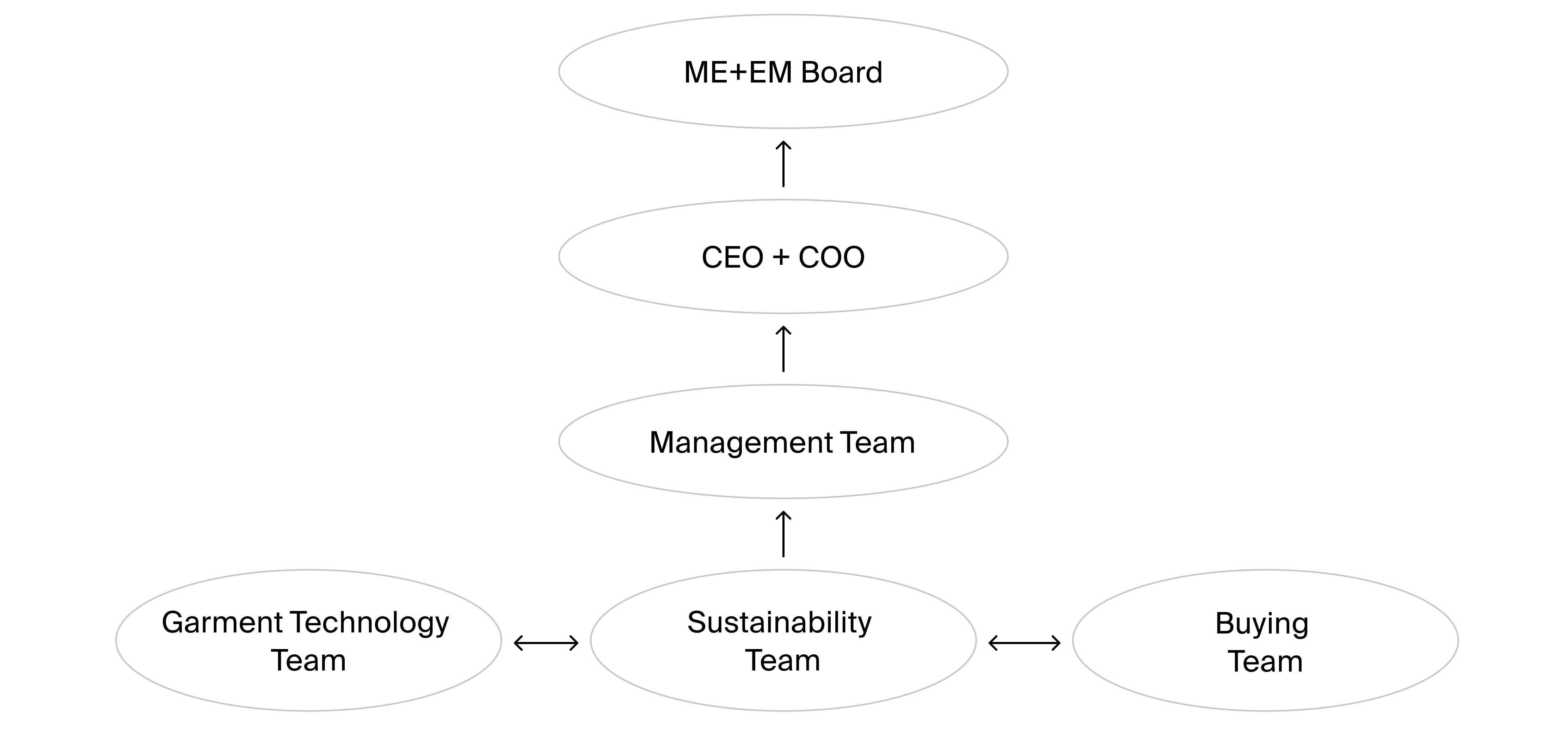
ME+EM has established a governance framework with policies and processes to embed CSR across its operations. The Board and Senior Leadership team oversee CSR matters, including identifying, mitigating, and addressing human rights risks such as modern slavery, including responses to any human rights violations.This framework ensures accountability and effective management of social, environmental, and governance issues.
The CSR team is composed of department leaders and a dedicated CSR team, which includes a Head of CSR, Ethical Trade Manager and Sustainability Coordinator. The business has invested in a specific resource to manage ethical trade, focusing on supplier compliance, social auditing, traceability, and supply chain mapping.
ME+EM Direct Employees
For direct employees, we carry out appropriate due diligence on the right to work and appropriate supporting documentation. All employees directly employed by us receive training and a comprehensive handbook which outlines our policies on:
Whistleblowing Policy
Anti-Bribery + Corruption Policy
Disciplinary Policy
Modern Slavery + Human Trafficking Policy
Grievance Policy
Diversity, equality and inclusivity policy
This handbook is regularly updated and easily accessible through our human resources online platform.
Living Wages
In 2022, ME+EM became an accredited Living Wage Employer, committing to pay a fair wage based on the real cost of living, not just the government minimum. This applies to both our employees and third-party contracted staff, reinforcing our belief that respect for human rights starts with fair pay.
Partnerships
Collective action and partnerships with key organisations are crucial for driving systemic change. We utilise the following frameworks to ensure transparency and robust protection of workers' rights:
Standard | Summary |
|---|---|
Ethical Trading Initiative (ETI) | As full members, we adopt the ETI Base Code as our core standard to protect workers' rights, ensuring employment is freely chosen and providing a framework to prevent and detect forced labour. |
Sedex + SMETA | We use the SMETA audit framework to increase supply chain transparency and rigorously monitor working conditions, allowing us to proactively identify and mitigate human rights risks across our global suppliers. |
Textile Exchange | We utilise Textile Exchange standards to ensure social accountability within our raw material supply chains, verifying that labour practices at the farm level meet our strict ethical requirements. |
Good Cashmere Standard | This standard enforces social criteria that protect the rights and working conditions of herders, providing essential oversight in regions with heightened vulnerability to labour exploitation. |
Leather Working Group | Our membership facilitates greater transparency within leather manufacturing, enabling us to better monitor labour standards and uphold human rights within this complex supply chain tier. |
Positive Luxury - Butterfly Mark
In recognition of our sustainability and ethical trade commitments and actions we achieved Positive Luxury’s Butterfly Mark certification. This assessment means ME+EM have independent validation at brand level and have been comprehensively assessed and scored against all key areas of CSR. Our performance has also been assessed against international agreements, global frameworks, standards and legislation.
We spent over 12 months working through the assessment process covering 400 questions with supporting evidence required. This assessment was led by the CSR function with key inputs from the People Team. The assessment modules cover Social, Governance and Environment. Data from all existing projects was used such as carbon capture, net zero strategy, audit information, certified material usage, responsible purchasing practices, supplier policies and chemical compliance information.
Our Supplier Relationships
We understand that transparency and traceability within our business relationships are crucial for us to understand where there could be vulnerabilities for occurrences of modern slavery and human rights abuses. We categorise our relationships with suppliers as:
- Non-Stock Suppliers who provide purchased services to support the operations of the business. These include logistics, printing, packaging, real estate, legal, warehousing and office facilities.
- Stock Supply chains are integral to the manufacturing of our collections that includes production sites, trim providers, laundries, fabric mills and raw material producers.
All our supplier relationships are important and carry varying degrees of risk. While our stock supply chain requires a tailored, intensive focus due to the complexities of manufacturing, we have implemented standard processes for our non-stock suppliers and are committed to building upon these in 2026-2027 and beyond as part of our continuous improvement roadmap.
Supply Chain Overview
We manage our sourcing network with a strategic, risk-based approach to ensure our partners align with our commitment to human rights and ethical trade. By prioritising long term, direct relationships, we gain essential visibility into production sites, enabling robust monitoring and collaborative risk mitigation from the outset.ME+EM manufactures finished goods through a global network of 3rd party suppliers and source materials through the same network and direct routes. We have 60 suppliers spanning the globe with 73 tier 1 factories. Our sourcing countries with the highest volume include Portugal, Turkey, Italy, China and India. Our supply chain workforce comprises approximately 59% female and 41% male workers.
Tier 1 production sites represent just one element of our global supply chain. Modern slavery risks intensify within lower tiers, where operational oversight is limited. Adopting a strategy that goes 'beyond audit' is crucial for uncovering hidden risks.
To address these challenges, we have begun mapping our stock supply chain. Each tier is systematically evaluated according to risk level and our ethical roadmap, taking into account both manufacturing type and geographic location.
Our supply chain is split into the following tiers:
Tier | Definition | Description | Status |
|---|---|---|---|
Tier 1 | Main production site | Principal manufacturing location of our collections | Fully mapped |
Tier 2 | Secondary site | Sewing, cutting, laundry | Partially mapped |
Tier 3 | Fabrics and components | Fabric mills and trims | Partially mapped |
Tier 4 | Raw materials | Farmer | Partially mapped |
Supply Base by country across Clothing, Footwear + Accessories
Country | Number of Suppliers | Number of Sites |
|---|---|---|
Turkey | 14 | 16 |
Portugal | 13 | 14 |
Italy | 11 | 11 |
China | 8 | 15 |
India | 4 | 6 |
Spain | 2 | 2 |
Mauritus | 1 | 1 |
UK | 1 | 1 |
Romania | 2 | 2 |
Germany | 1 | 1 |
Bulgaria | 1 | 1 |
Nepal | 1 | 1 |
Sri Lanka | 1 | 1 |
Vietnam | 1 |
We maintain a comprehensive Corporate Social Responsibility (CSR) policy, which all suppliers must adhere to as a condition of business. This policy is foundational to our Ethical Trading strategy and outlines our strict requirements regarding human rights, including prohibitions against modern slavery, human trafficking, and child labour. While we have robust policies currently in place, we are actively strengthening our standards and expectations, in Q4 2026, we are introducing a redeveloped supplier manual featuring a dedicated, enhanced CSR section. This manual will further integrate our requirements into contractual agreements, ensuring that all suppliers not only understand but proactively meet our elevated expectations for ethical conduct and labour rights.
Supplier Auditing
We are an engaged member of the Sedex community and use their globally recognised auditing methodology Sedex Members Ethical Trade Audit (SMETA) as the benchmark for monitoring and assessing our suppliers’ approach and performance to prevent human rights violations in their supply chains.
SMETA audits are governed by the standards contained in the Ethical Trading Initiative base code and the International Labour Organisation conventions human rights treaties. The audit reports for our suppliers are held on the Sedex database which is also used as an interactive tool for suppliers to upload appropriate information that gives us greater visibility of their ethical practices.
In the event that a supplier has an audit where non-compliances are found, they are given a summary of the action required to resolve the non-compliance and a time frame in which to satisfy the auditors recommendations. All active ME+EM suppliers must provide an audit annually, previously only held for sites in China and Turkey where we have strengthened our requirements. We have been working with our suppliers to conduct SMETA audits as our preferred auditing methodology. We are pleased that 98% have achieved this, including our top 10 manufacturing sites up 10% in the last 12 months.
Reporting
We have developed an internal reporting system to capture and monitor supplier audit outcomes, with a focus on identifying and addressing any non-compliances related to labour standards. Each issue is assessed for severity, and we apply our own scoring to ensure prompt and proportionate remediation with the supplier. While SMETA audits recommend timelines for resolution, we require faster action where a potential risk is identified. Audit outcomes are presented in a dashboard separated by supplier origin, enabling us to identify regional trends and systemic risks. Key findings and priority actions are shared at executive level on a monthly basis to ensure accountability and continuous improvement.
Cotton Sourcing + Banned Regions
We recognise the significant risk of modern slavery in global cotton supply chains, particularly within lower tiers. To address this, we have implemented a strict cotton sourcing policy that prohibits any sourcing from Uzbekistan, Turkmenistan, and China due to credible evidence of forced labour and human rights violations in these regions. Our broader Forced Labour and Human Trafficking Policy further extends these protections by banning all business operations and sourcing from Uzbekistan, Turkmenistan, Myanmar, and the Xinjiang Uyghur Autonomous Region (XUAR) in China.
To effectively mitigate these inherent risks, we are committed to increasing our use of certified, organic cotton. These certification standards provide vital traceability back to the source and ensure that strict social and ethical standards are rigorously upheld throughout the supply chain.
Whistle Blowing and Grievance Mechanisms
We provide a whistle blowing procedure in the employee handbook which explains how an employee can communicate their concern through internal escalation or contact details for an independent organisation where advice and support can be obtained. In addition to this we provide contact details for a dedicated modern slavery helpline. As part of our forward objectives we will be assessing grievance and whistleblowing mechanism options for our stock suppliers.
Freedom of Association + Collective Bargaining
ME+EM recognises freedom of association and the right to collective bargaining as fundamental human rights, grounded in our commitment to the ETI Base Code. We are dedicated to ensuring these rights are respected across our supply chain; however, we acknowledge the challenges in high risk regions, particularly in China and Turkey, where legislative restrictions can limit formal union activity.
We are dedicated to supporting worker representation and promoting direct, open channels for dialogue, particularly where traditional union activity faces barriers. We view this as an evolving area of our due diligence and are actively taking steps to strengthen our oversight, including:
Identifying existing representation: Mapping suppliers with established worker committees or representative bodies.
Engaging external partners: Proactively building links with NGOs and labour rights experts to facilitate worker dialogue where traditional channels are restricted.
Enhancing monitoring: Integrating worker engagement metrics into our regular supply chain risk assessments to ensure we remain vigilant and responsive to worker needs.
Supply Chain Risk Assessment
Our CSR team takes a risk-based approach to human rights due diligence, prioritising suppliers and sourcing regions where workers may be at greater risk of adverse human rights impacts. Through the creation of our internal dashboard we can understand risk by county and region which dictates our focus. We use multiple sources to identify risks in our supply chain, including the Sedex suite of risk tools that combines information from several sources including:
ILO (International Labour Organisation)
Walk FreeUNDP (United Nations Development Programme)
WEF (World Economic Forum)
ITUC (International Trade Union Confederation)
UNICEF
We monitor and assess our supply chain through factory visits, social audits, risk assessment tools, and our own supplier reviews. As members of the Ethical Trading Initiative (ETI), we engage with global issues affecting workers, such as displaced people from Ukraine and the 2023 earthquakes in Turkey.
We conduct periodic risk assessments across our supply chain to identify, monitor, and mitigate inherent and supplier specific sourcing risks. Our assessments utilise the comprehensive Sedex risk reporting framework, covering country, region, and sector risks, as well as forced labour insights and audit indicator details.
The CSR team analyses risk ratings for our main sourcing countries, based on a review of key labour issues including discrimination, forced labour, freedom of association, child labour, gender, employment, wages, and working hours.
Salient Human Rights and Modern Slavery Risks
Our 2025-26 risk assessment identified India, Nepal, Sri Lanka, Turkey, and China as the sourcing countries with the highest inherent exposure to labour rights and modern slavery risks, based on Sedex country risk indicators. India recorded the highest overall risk score, with elevated indicators across all assessed labour rights categories, including forced labour and excessive working hours.
Across our sourcing regions, we have identified the following priority areas of salient human rights risk:
Forced labour: Particularly affecting migrant, temporary, agency and subcontracted workers, who may be more vulnerable to exploitative recruitment practices, restricted freedom of association and debt bondage.
Restricted freedom of association: Risks associated with limitations on worker representation, collective bargaining and access to effective grievance mechanisms.
Excessive working hours: Risks associated with production pressures, capacity constraints and inadequate working time management, particularly within manufacturing operations.
These risks are assessed through a combination of independent social audits, supplier engagement, Sedex risk intelligence and targeted in-country assessments.
Importantly, country and sector risk indicators represent potential exposure and do not indicate that violations have occurred within ME+EM’s supply chain.
We recognise that social audits alone cannot provide complete assurance, particularly where risks may be concealed or occur beyond direct manufacturing partners. We therefore continue to strengthen our approach through greater supply chain visibility, local expertise and ongoing engagements with suppliers.
Risk Mitigation and Priorities
Our approach focuses on identifying potential adverse human rights impacts, prioritising action according to risk and supporting meaningful improvements in working conditions.
Building on our existing ethical trade programme, our priorities include:
Strengthening supply chain transparency: Implementing Textile Genesis to improve visibility beyond direct suppliers and support more targeted human rights due diligence across our extended supply chain.
Enhancing supplier engagement: Engaging independent in-country expertise to provide targeted support to suppliers where additional guidance or intervention can strengthen working conditions and worker wellbeing.
Improving corrective action and remediation: Working collaboratively with suppliers to address identified non-compliances, monitor progress and support sustainable improvements.
Embedding responsible purchasing practices: Continuing to strengthen internal awareness and training to help ensure commercial decisions support responsible working conditions.
Strengthening worker voice: Exploring opportunities to improve access to effective worker feedback.
These measures will support the continued development of our human rights due diligence programme, enabling us to direct resources towards areas of greatest risk and prioritise positive outcomes for workers.
Compliance + Policies
We believe everyone in our global supply chain deserves the rights and protections as set out in the ETI Code of Conduct. This Code underpins our Ethical Trading strategy, which includes supplier monitoring and auditing. All ME+EM suppliers must adhere to our CSR policy in full, which includes the following declarations:
CSR Declaration and latest Audit
Animal Testing and Animal Welfare Policy and Declaration
Code of Conduct Policy and Declaration
Forced Labour and Human Trafficking Policy and Declaration
Cotton Sourcing Policy and Declaration
Anti-Bribery policy and Declaration
Restricted Substances Policy and Declaration
Data Protection Policy and Declaration
We prohibit sourcing from the Xinjiang Uyghur Autonomous Region and are part of the Coalition to End Forced Labour in collaboration with Anti-Slavery International. We demonstrate our commitment to best practice and responsible sourcing through our collaboration with recognised industry bodies and adoption of their standards. To strengthen traceability and risk management, we are members of the Leather Working Group (since 2022) and Textile Exchange (since 2023), achieving the Responsible Animal Fiber certification. We also expanded our use of certified materials by becoming members of the Good Cashmere Standard (since 2025)
We review auditing dashboards monthly at leadership level. Any evidence of human rights violations would be escalated to the board with recommended actions. Our priority is protecting workers, whether by working with suppliers on remediation or, where necessary, responsibly ending relationships.
We actively mitigate risk through a structured, proactive strategy. Following audits, we enforce a strict follow up process, requiring prompt acknowledgment and remediation of any non-compliance. We maintain strict control of our supply base, particularly in China and Turkey. Oversight is reinforced by our Product and CSR teams, who integrate risk assessments into every site visit, while monthly risk updates ensure direct senior management accountability. We prioritise transparency and supplier engagement through regular communication and feedback.
Vulnerable Worker Groups
We recognise that specific groups, including migrant, refugee, female, and temporary/subcontracted workers, face heightened risks of modern slavery, often exacerbated by seasonal production pressures.
For migrant workers in our top 5 manufacturing countries (Portugal, China, Italy, Turkey, India), we actively collect and analyse audit data to monitor worker representation and robust HR practices.To mitigate risks for temporary and subcontracted workers, we are proactively mapping subcontractors beyond Tier 1 and investing in traceability platforms. We enforce strict controls by requiring prior approval for all third-party sites and are partnering with independent in-country CSR consultants to enhance oversight, ensuring suppliers responsibly manage their production capacity.
Our Achievements
2025-2026 Achievements | Status and actions | |
|---|---|---|
Supplier Compliance and Auditing | Strengthen onboarding process | Complete |
Independently audit top 5-10 suppliers/factories | Carried out independent assessments of 3 key sites in Turkey | |
100% top 10 suppliers rated Amber or Green | 90% | |
Review policy compliance and conduct due diligence | Complete | |
Supplier engagement | Deliver Supplier engagement sessions | Complete - specific engagement with Turkish suppliers |
Review and develop robust approach to worker engagement and dialogue projects including grievance mechanism mapping and implementation | Complete - reviewed top 5 supplier factories | |
Monitor and assess supply chain risk across supplier base, establishing risk mitigation plans | Review and strengthen risk assessment process | Complete |
Develop and implement risk escalation for suppliers | Complete | |
Scope non-stock screening process | Planned for Q4 2026 | |
Scope a just transition and heat stress policy | Complete | |
Increase understanding of Living Wages compliance in our supply chain | Complete - reviewed top 5 supplier factories | |
Supply chain mapping | Implement robust supply chain mapping process across key suppliers and materials | Ongoing - Good Cashmere Standard and Eurofins leather supply chain mapping project |
Map and verify 100% of tier 1 suppliers | Complete | |
Identify and map tier 2 processes | Complete | |
Advance internal understanding of CSR | Conduct Modern Slavery and purchase practice training for relevant teams | Purchase practice training complete |
Implement regular reporting for key stakeholders on compliance and key activities | Ongoing |
Activity Highlights
Leather Supply Chain Mapping
ME+EM partnered with Eurofins to undertake a targeted mapping exercise across our leather supply chain, covering clothing, footwear and accessories. The project has strengthened supplier engagement, improved traceability back to source and increased visibility of potential risks within lower tiers of our supply chain. This work has also laid important foundations for the adoption of Textile Genesis and the next phase of our supply chain traceability programme.
Turkey: Enhanced in-Country Due Diligence
Recognising Turkey as a priority sourcing region, we engaged independent in-Country CSR expertise to undertake targeted supplier assessments beyond traditional social auditing. This approach has enabled us to gain deeper insight into working practices, identify root causes of non-compliance and provide suppliers with practical guidance and tools to support meaningful, longer term improvements for workers.
Escalation ProcedureWe have implemented a comprehensive escalation procedure for identifying and addressing human rights risks, ensuring all issues are managed according to their severity and urgency.
Buying Team EngagementIn 2025-2026 we implemented 1:1 meetings between Senior Buyers and the Ethical Trade Manager to ensure full visibility of our supplier base. These sessions proactively identify risks, review sourcing changes, and align our buying teams on human rights due diligence.
Our Programme in ActionTo date, we have received no reports of modern slavery through our internal grievance or whistleblowing procedures from ME+EM employees. In 2025/2026, we achieved 100% audit visibility across our active supplier base. While this process has not uncovered evidence of modern slavery, we remain vigilant. In the coming financial year, we are developing enhanced KPIs to monitor the effectiveness of our human rights initiatives, with a specific focus on training and supplier engagement. Our approach is fundamentally rooted in partnership. We actively support our suppliers by subsidising audit costs and providing guidance throughout the remediation process, demonstrating our dedication to continuous improvement. Compliance is an ongoing evolution, and we are continuously refining our due diligence frameworks to detect indicators that might otherwise be hidden, reinforcing our absolute zero-tolerance stance.
This 'beyond audit' approach has been essential in identifying risks. We are committed to continuing these independent expert assessments throughout 2026–2027 as a core part of our due diligence and support processes for suppliers who need extra help to improve.
Reflections + Learnings
Whilst we have made significant progress in enhancing supply chain visibility and risk mitigation, we recognise that our journey toward full transparency is complex and that systemic challenges remain. We treat these vulnerabilities with the utmost seriousness, maintaining a continuous commitment to the rights and wellbeing of all individuals in our global supply chain. Informed by the insights gained this year, we have embedded a robust, long term strategic roadmap designed to proactively identify, manage, and address these risks, ensuring our continuous evolution towards increasingly responsible and sustainable business practices.
ME+EM has made a significant strategic investment in Textile Genesis, a digital supply chain mapping and traceability platform, to support the next phase of our traceability and transparency and transparency programme, strengthening visibility across our supply chain and enhancing our ability to identify, assess and manage potential human rights risks.
Responsible Purchase Practice Training
In April 2026, we partnered with the Ethical Trading Initiative (ETI) to train our buying team on responsible purchasing practices. This session examined supplier relationships, extreme heat impacts, and just transitions, providing our team with frameworks and action plans to mitigate exploitation risks. We are currently evaluating 2026–2027 training options to further empower our teams to embed ethical considerations into every decision.
Just Transitions
Recognising extreme heat’s growing impact on our supply chain and workers, we hold meetings with key factories to understand their challenges and foster information sharing. To build our expertise and optimise our support, we regularly attend related webinars and in-person sessions, including the ETI’s Accelerating just transition in fashion workshop during London Climate Action Week.
Communication
Communication is central to our zero tolerance approach. In Q4 2026, we will implement our redeveloped supplier manual, featuring a dedicated CSR section to strengthen our standards and expectations. Internally, our CSR team ensures human rights remain a priority through regular sharing of audit results, risk alerts, and our new internal CSR newsletter. Externally, we foster strong, long-term supplier relationships, some spanning over 15 years, through open dialogue, performance reviews, and site visits that serve as both assessment and training opportunities.
2026-2027 Objectives and Targets | |
|---|---|
Supplier Compliance and Auditing | Roll out new Supplier Manual to all tier 1 suppliers, including, enforceable compliance clauses matching the upcoming EU Forced Labour Regulation (FLR) requirements |
Engage in-country expertise to provide targeted support to suppliers where additional guidance or intervention can strengthen working conditions | |
100% top 10 suppliers rated Green | |
Supplier engagement | Deliver Supplier engagement sessions across key sourcing regions |
Review implementation of confidential, independently verified worker voice and grievance apps or mechanisms | |
Map and assess supply chain readiness for just transitions, identifying how best to support key suppliers | |
Monitor and assess supply chain risk across supplier base, establishing risk mitigation plans | Carry out in-depth assessment and analysis of Turkey, India, Sri Lanka and China supply chains to establish robust mitigation and prevention processes |
Scope non-stock screening process and implement code of conduct to all existing and new suppliers | |
Conduct a phased living wage gap assessment for the top 10% of our manufacturing supply chain to build a foundation for a realistic wage improvement roadmap | |
Supply chain mapping | Engage a full supply chain mapping platform and roll out to high risk material suppliers (Textile Genesis) |
Advance internal understanding of CSR | Conduct purchase practice training and Modern Slavery awareness training for relevant teams |
Implement regular reporting for key stakeholders on compliance and key activities | |
Continue internal newsletters to build engagement and knowledge of CSR practices at ME+EM |
This statement has been published in accordance with the Modern Slavery Act 2015. It sets out the steps taken by ME and EM Ltd to aid in the prevention of modern slavery and human trafficking in its business operations and supply chains during the 2024-25 reporting year. UK company registration: 05686460. The modern slavery statement has full sign off by the Executive Board.
Clare Hornby, CEO, on behalf of the board of directors.
Appendix
UK Modern Slavery Act 2015
Under the UK Act, companies providing goods and services in the country, with UK operations and a turnover of £36m or more are obliged to publish an annual Modern Slavery and Human Trafficking Statement setting out the steps they have taken to ensure modern slavery and human trafficking is not taking place in their supply chain or own business.
What is Modern Slavery?
Form | Definition |
|---|---|
Human Trafficking | A process of bringing a person into a situation of exploitation through a series of actions, including deceptive recruitment and coercion. |
Forced Labour | Any work or services which people are not doing voluntarily, and which is exacted under a threat of some form of punishment. |
Bonded Labour | Labour demanded as a means of repayment of a debt or a loan. |
Slavery | A situation where a person exercises (perceived) power of ownership over another person. |